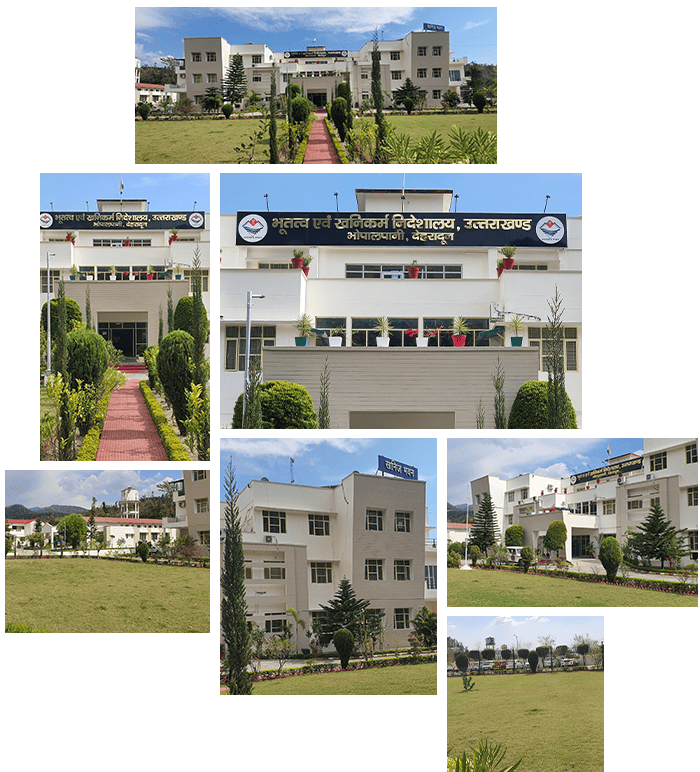
Geology and mining Unit, Directorate of Industries, Uttarakhand is an individual unit under the administrative control of the Department of the Industrial Development, Government of Uttarakhand. Its headquarter is situated in the State Capital Dehradun. It is located at Bhopalpani, about 20 km east of Dehradun City near the 8 km milestone from Raipur(Sports College) on Raipur-Thano-Airport motor road and further 900 m upstream from the main road along the seasonal Badasu nala.
1. Historical Background
Uttarakhand State has a long and fascinating past of mining of minerals. Placer Gold, Copper and Iron ores have been extracted / mined in this part of Himalayan terrain on a very small scale over a hundred years ago. Prior to 1900, Copper ores were being mined on a very small scale in Garhwal division. The expansion of modern technology and decline in the prices also lead to the decline of small-scale mining. Mining activity between 1920 and 1930 further declined on account of several social reasons. The Geologists have been examining the ground for search of both industrial and metallic mineral deposits which can be developed with respect to Technology and economics in contemporary times.
After independence in 1947, the first concern and emphasis were laid on developing the agricultural front and building the essential infrastructures for gradual development of industries.
In 1950-51 the Government of India enacted Industries Development Regulations Act, 1951 for controlling the grant of industrial licenses with a view to promote industries in the desired fields. This step also initiated serious efforts for exploring and exploiting the vast resources of the country. Activities of Geological survey of India was intensified and expanded. A number of departments for handling specialized investigations for the search and development of oil and natural gas, atomic energy and coal were introduced. Energy and minerals were assigned top priorities. Various departments for survey of minerals were established in almost all the States within the next five or six years for intensive exploration of mineral resources.
In Uttar Pradesh the first investment towards the mineral based industry was made by the State Government in the later part of the first “Five Year Plan” when a cement plant to produce 700 tonnes of cement per day was established in Churk, District Mirzapur in 1953. This was followed by the creation of Directorate of Geology and Mining (DGM) in 1955 for exploring mineral potential of the State for proper development of mineral based industries.
The State Directorate having baseline general reconnaissance and preliminary investigation, gradually intensified its activities from second “Five Year Plan” onwards to evaluate and outline mineral reserves in different areas of the State.
The “Directorate of Geology & Mining” was set up in the erstwhile state of Uttar Pradesh in the year 1955 with a core staff for geological exploration of mineral resources of the State. Since the year 1963, the Directorate of Geology & Mining was also entrusted with the responsibility of advising the State Government in matters regarding grant of mineral concessions and regularizing the mining work for
- Proper development of minerals and mineral based industry
- Maximizing the Government revenues through royalties
These were aided by (i) Geochemical Survey (ii) Geophysical Survey (iii) Surveying (iv) Chemical Analysis (v) Petrological Studies (vi) Drilling (vii) Ore-dressing (viii) Droughting (ix) X-ray Fluorescence (XRF) Laboratory and (x) Remote Sensing and Photo-geology.
In 1984, two Engineering Geology Cells were established in Srinagar (Garhwal), the then hilly areas of Uttar Pradesh to assess geotechnical aspects of Garhwal and Kumaon Divisions respectively. In 1989, these two “Engineering Geological Cells” were converted into Task Force Offices headed by geologists, one for each Hill District of the then Uttar Pradesh. Further, Task Force Offices were opened in all the eight Districts, viz., Dehradun, Tehri, Uttarkashi, Pauri, Chamoli (Garhwal Region/Division), Nainital, Almora, and Pithoragarh (Kumaon Region/Division).
In 1993, Directorate of Geology & Mining, UP decentralized its offices by putting up its offices as Regional Office, Haldwani (District Nainital) and Regional Office, Dehradun (District Dehradun) for technical supervision of the Task Force Offices to cut short the time-consuming financial procedures. The objective of this entire activity was to provide geotechnical advice and administrative support to the district administration at the district level itself.
At the time of the creation of the State of “Uttaranchal” on 09-11-2000 (renamed as ‘Uttarakhand’ from 01-01-2007) both the Regional Offices at Haldwani (District Nainital) and at Dehradun were being headed by the Deputy Directors. The Deputy Director posted at Regional Office, Dehradun, who was earlier functioning as the Nodal Officer also, was made Officer-in-charge of the Department of Geology and Mining, renaming it as “Geology and Mining Unit” and bringing it under control of the Director, Directorate of Industries, who was, ex officio, the Secretary of the Industrial Development, Government of Uttarakhand.
At the time of the creation of the State of “Uttaranchal” on 09-11-2000 (renamed as ‘Uttarakhand’ from 01-01-2007) both the Regional Offices at Haldwani (District Nainital) and at Dehradun were being headed by the Deputy Directors. The Deputy Director posted at Regional Office, Dehradun, who was earlier functioning as the Nodal Officer also, was made Officer-in-charge of the Department of Geology and Mining, renaming it as “Geology and Mining Unit” and bringing it under control of the Director, Directorate of Industries, who was, ex officio, the Secretary of the Industrial Development, Government of Uttarakhand.
- Geotechnical studies to advise the State Government on the matters related to civil works, mining activities, disaster management and slope-stabilization wherever required.
- Mineral exploration and development.
- Mining administration including the legal and matters related to litigations.
Directorate of Geology & Mining Headquarter shifted to its own building on 22-06-2010, at Bhopalpani, P.O. Badasi, Raipur-Thano Road, District Dehradun, which is approximately 20 kms from Clock Tower on the eastern outskirts of Dehradun city. On 22-12-2011, the structure of the ‘Directorate of Geology & Mining’ was modified in which ‘Geology Wing’ and ‘Mining Wing’ were separated. The above information is sourced from official website of Directorate of Geology & Mining i.e. https://dgm.uk.gov.in/.
2. About Directorate of Geology & Mining, Uttarakhand
Directorate of Geology & Mining is a multi-disciplinary earth science organization under the Department of Industrial Development, Government of Uttarakhand, having total sanctioned strength of 181 employees from different cadres, viz., Geology, Mining, Chemistry, Geochemistry, Geophysics, Drilling, Surveying and Cartography.
Main functions of the Directorate of Geology & Mining are Geotechnical Studies and works for development and management of mineral resources, which are essential for the economic development of the State.
Geotechnical Studies are of critical importance in the hill state of Uttarakhand which has a very fragile ecosystem. The hill regions are particularly prone to natural hazards like earthquakes, landslides and flash flood etc. It is therefore necessary that before allowing any civil construction, detailed geological-geotechnical study of the proposed construction site is carried out and suitability of the site is considered while clearing it for construction. Preliminary geological-geotechnical studies of buildings, roads, canals, power transmission lines etc. sites are being carried out by the Unit. As per the current status, there are around 141 mining Leases of Soapstone, 200 Riverbed mining sites, around 416 Stone Crusher/Screening Plant and 187 Retail Mineral stock in the State.
The activities concerning minerals and mining include:
- Ensuring judicious mineral exploration and exploitation
- Building up a mineral database of the State
- Providing the geological / mineral information to the State and entrepreneurs
- Acting as a Nodal Agency for collection, compilation, analysis and dissemination of geological / mineral related information in the state
- Processing of Mineral Concession Applications
- Monitoring of royalty, periodical revision of minor mineral royalties, and the related legal aspects are also looked after.
- Granting permissions for stone crushers / screening plants / pulverizing plants, etc.
Environmental Impact Assessment (EIA) studies of mining areas are being conducted by specifically established “EIA Cell” in the Unit. The aim of the cell is to promote conservation and scientific development of mineral resources. The EIA Cell will monitor the impact of mining activities on the environment, the approval and execution of the mining plans, and execution of Environmental Management Plan (EMP).
Above as well as other wide range of information is being disseminated by Directorate of Geology & Mining through their website https://dgm.uk.gov.in/.